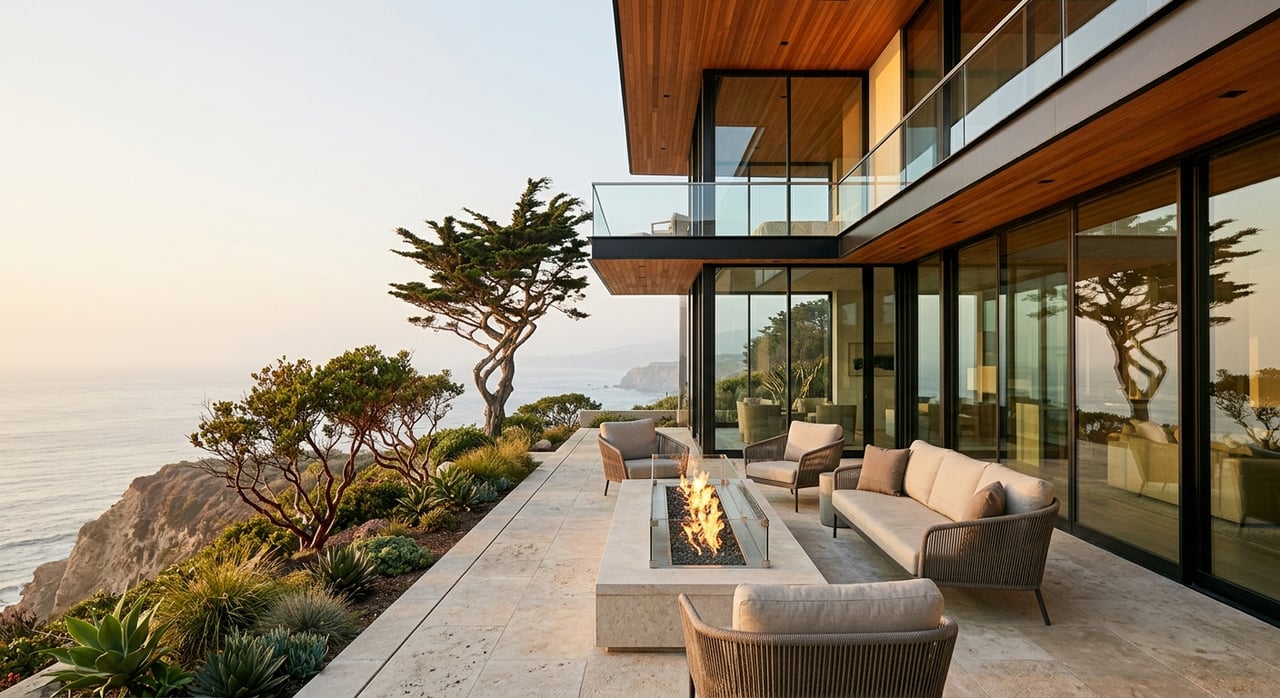
Looking for a coastal retreat around Carmel often starts with a simple question: what kind of escape do you actually want? In this part of Monterey County, “Carmel” is not one uniform market. It is a collection of distinct settings, each with its own balance of walkability, privacy, scenery, access, and ownership considerations. If you are considering a primary residence, second home, or long-term lifestyle purchase, understanding those differences can help you focus your search with far more clarity. Let’s dive in.
Carmel Is a Spectrum of Retreat Styles
One of the most useful ways to think about Carmel is as a ladder of retreat options rather than a single destination. You can move from village-oriented neighborhoods near the heart of Carmel-by-the-Sea to more secluded coastal enclaves, controlled-access resort settings, and inland properties with more land and rural character.
That framework reflects how the area is actually planned and experienced. The City of Carmel-by-the-Sea has retained its village character since 1916, and the city sits entirely within the coastal zone. Local planning also places strong emphasis on coastal access, recreation, resource management, and design guidelines, which shape both the feel of the community and the ownership experience.
Close-In Carmel for Walkable Retreat Living
If you want your retreat to feel leafy, charming, and close to daily conveniences, the close-in Carmel neighborhoods often stand out first. Monterey County describes Carmel Woods, Hatton Fields, Mission Fields, Mission Tract, and Carmel Point as more urbanized than the more secluded coastal enclaves, with smaller parcels, higher densities, and easier access to commercial services in Carmel and near the mouth of Carmel Valley.
For many buyers, that means you can enjoy the classic Carmel atmosphere without feeling isolated. You may be close to the beach, tucked among mature trees, and still within reach of the village experience that makes this market so distinctive.
Carmel-by-the-Sea also carries a sense of place that feels different from most California markets. The city notes that it has no street addresses, and homes are often identified by relative location or by name. That detail may seem small, but it reinforces the old-village character that draws many buyers to the area in the first place.
Village Character Shapes the Experience
The appeal of close-in Carmel is not only architectural or visual. It is also about rhythm. If you picture a retreat where you can enjoy a walkable setting, spend time near Carmel Beach, and stay connected to the village core, this part of the market tends to align best.
The city also highlights nine park and open-space areas, which add to that everyday sense of access to nature. Mission Trail Nature Preserve, for example, includes a 34-acre, three-mile hiking network with Monterey pine forest, coast live oak woodland, wetland, willow riparian corridor, and coastal prairie.
Carmel Highlands and Carmel Meadows for Seclusion
If your idea of a retreat centers on privacy, topography, and a stronger sense of separation, the conversation often shifts south and west. Carmel Highlands-Riviera is one of the clearest examples of a more secluded coastal retreat setting.
Monterey County describes Carmel Highlands-Riviera as a residential enclave between Point Lobos Reserve and Malpaso Creek. Parcels are typically one-half to one acre, and the area has the largest average parcel size and lowest density among the major Carmel residential enclaves.
That lower-density pattern changes how the area feels. Internal roads are generally narrow, steep, and winding, and future development is constrained by steep slopes and shallow soils. For buyers who value quiet, terrain, and dramatic separation from busier village areas, those conditions are often part of the appeal.
Carmel Meadows also offers a more tucked-away feel. The county treats it as a distinct residential enclave because the Carmel River and agricultural land separate it from the more urban Carmel area. If you want a coastal setting that feels less immediate to the village core, Carmel Meadows may fit that preference.
Scenic Protection Matters Along the Coast
Privacy in the Carmel coastal market often comes with additional land-use considerations. County policy for the Carmel coast specifically calls for protecting visual access to the shoreline from major public corridors and residential roads in Carmel Highlands-Riviera.
For buyers, that is worth understanding early. In this part of the market, scenic character is not just an amenity. It is also something local planning actively seeks to preserve.
Pebble Beach for Managed Privacy and Amenities
At the high-privacy, high-amenity end of the retreat spectrum, Pebble Beach occupies a very different niche. County materials describe Pebble Beach as an exclusive gated community, which immediately sets it apart from the open, village-oriented feel of Carmel-by-the-Sea.
The Del Monte Forest public-use agreement adds more context. Forest roads are privately owned and maintained by Pebble Beach Company, and the public may enter Del Monte Forest and use 17-Mile Drive during daylight hours, subject to an entrance fee. Other forest roads are mainly intended for local residential traffic.
That combination creates a distinct ownership environment. Rather than the casual accessibility of in-town Carmel, Pebble Beach tends to offer a stronger sense of managed access, seclusion, and resort infrastructure.
How Pebble Beach Feels Different
For some buyers, Pebble Beach is less about a village retreat and more about a private resort lifestyle. It tends to appeal to those who value controlled access, golf-oriented surroundings, and a setting where forest, coastline, and residential privacy work together.
County land-use policy also emphasizes shoreline access, public viewsheds, and scenic character in this broader area. So even in highly private settings, stewardship and visual preservation remain part of the local framework.
Carmel Valley for Space and Rural Character
If your vision of a retreat includes more room to spread out, Carmel Valley offers a different expression of Central Coast living. County sources describe the valley as stretching 15 miles from Cahoon Ranch to Carmel Bay and as bordered by the Sierra de Salinas and the Santa Lucia Range.
This is the most space-oriented option in the broader Carmel orbit. Access is primarily via Carmel Valley Road and Laureles Grade, and the setting generally reads as more inland, more open, and more rural than the coastal neighborhoods.
The Carmel Valley Master Plan also helps explain the area’s character. It calls for village development to follow a rural architectural theme, says visitor accommodations should respect the privacy and rural residential character of adjacent properties, and encourages equestrian-oriented recreation.
For buyers who are drawn to estate-scale living, more land, or equestrian-adjacent surroundings, Carmel Valley may be the strongest match. It is less about immediate coastal proximity and more about space, privacy, and a distinctly rural atmosphere.
Access Can Make a Second Home Easier
Even when a property feels wonderfully remote, practical access still matters, especially for second-home owners. Monterey County is connected by US Highway 101 and State Route 1, while State Route 68 links Salinas with the Monterey Peninsula.
Monterey Peninsula Airport also supports regional access with regular flights to San Francisco, Los Angeles, Phoenix, Denver, and Las Vegas, with about 40 flights in and out daily. For buyers coming from the Bay Area, Southern California, or out of state, that can make ownership more workable than the scenery alone might suggest.
Rental Rules Vary by Location
One of the most important practical issues for weekend and second-home buyers is rental use. Around Carmel, the answer is highly location-specific, and public zoning is only part of the story.
In Carmel-by-the-Sea, transient rentals are defined as stays of less than 30 days. They are prohibited in the single-family residential district and may only be possible in limited commercial contexts with city approvals and transient occupancy tax requirements.
In unincorporated Monterey County, the rules differ. Homestays and limited vacation rentals are allowed countywide with no cap, while commercial vacation rentals are capped by planning area.
In Del Monte Forest, vacation rentals may be permitted in some zoning districts, but private deed restrictions or CC&Rs and Pebble Beach Company objections can still affect what is actually practical. For buyers and sellers alike, that means the most useful answer is rarely general. It depends on the exact property, jurisdiction, and any private restrictions attached to ownership.
Coastal Ownership Comes With Stewardship
Because Carmel-by-the-Sea is entirely within the coastal zone, ownership often includes a stronger relationship to design review, shoreline management, coastal access, and long-term landscape stewardship. The city’s Local Coastal Program includes all of these elements.
Tree canopy is also an important part of the discussion. The city’s forest planning materials tie canopy management to wildfire risk, aging trees, climate stress, and long-term stewardship. If you are considering property in Carmel, it helps to see these issues not as side notes, but as part of the ownership experience.
Choosing the Right Retreat Style
The best Carmel-area retreat is usually not the one with the broadest appeal. It is the one that matches how you want to live when you are there.
If you want charm, walkability, and close connection to the village, the more urbanized Carmel neighborhoods may be the right starting point. If you prefer larger parcels and a quieter coastal setting, Carmel Highlands-Riviera or Carmel Meadows may offer a better fit.
If controlled access and resort infrastructure matter most, Pebble Beach may align with your goals. And if you are looking for more land, rural character, or equestrian-adjacent potential, Carmel Valley may deserve a closer look.
In a market this nuanced, local knowledge matters. If you are considering a purchase or planning a sale in Carmel, Pebble Beach, Carmel Highlands, or Carmel Valley, working with an advisor who understands the micro-markets, ownership nuances, and lifestyle tradeoffs can save time and sharpen your strategy. To start a thoughtful conversation about your options, connect with Michele Altman.
FAQs
Which Carmel-area neighborhoods are most walkable for a retreat home?
- Close-in Carmel neighborhoods such as Carmel Woods, Hatton Fields, Mission Fields, Mission Tract, and Carmel Point are generally the most walkable, with easier access to Carmel and nearby services.
Which Carmel-area locations feel the most private?
- Carmel Highlands-Riviera and parts of Pebble Beach and Del Monte Forest tend to feel the most private because of larger parcels, lower density, constrained roads, and more controlled access.
Which Carmel-area setting offers the most space?
- Carmel Valley generally offers the most room to spread out, along with a more rural setting and planning support for a rural architectural theme and equestrian-oriented recreation.
Can you rent out a second home in Carmel or Pebble Beach?
- Sometimes, but the answer depends on the specific jurisdiction, zoning, and any private deed restrictions or CC&Rs tied to the property.
What should buyers know about owning property in Carmel-by-the-Sea?
- Carmel-by-the-Sea is entirely within the coastal zone, so ownership may involve design guidelines, coastal access considerations, shoreline management policies, and ongoing tree and landscape stewardship.
Is Pebble Beach the same lifestyle as Carmel-by-the-Sea?
- No. Pebble Beach generally offers a more private, gated, resort-oriented environment, while Carmel-by-the-Sea is more village-oriented, walkable, and open in feel.